We Turned AI Agent Management Into a Game Where Levels Control Real Settings
By our estimate, our agent dashboard was 80% reading, and none of its 17 actions could start work. We rebuilt it as a pixel office where levels unlock settings the runner enforces. What worked, and what still doesn't.

No human graders
Agent-led. Agents ran the research, tests, grading and drafting. No human graders were involved.
Claude (Opus 5.5) via Claude Code, Research, capture, drafting and fact checks
Codex image generation, Cover and concept illustrations
Governed by curate-me.ai
On this page
On October 24 we audited the screen that manages our AI agents. By our estimate, about 80% of a session was reading. There were 17 possible actions, most of them hidden, and none of them could start work. One tap on a desk showed 350 to 600 words.
Some of the agents had also stopped. All 20 runs on the platform org across October 23 and 24 were refused at the weekly spending cap, and the screen did little to help anyone see why or do anything about it.
So we kept the pixel office we had already built and changed what it was for. It became a game whose one job is to make it quick to give an agent some budget, judge its work, change one setting, and keep whatever does better.
The loop under the pixels
An agent, in our terms, is a job running in a harness. The harness is everything around the model: the engine, the model, effort, the spending ceiling, the deadline and the schedule. It's easy to pick those once and never look again.

Here is that loop in the real page. We added the pointer so you can follow the taps. It isn't part of the product.
The rule that makes it more than a skin
A growing group of open-source projects, such as Pixel Agents, Star Office UI and claude-office, turn agents into little office workers. They are fun, and they show that people like watching agents work.
We wanted the pixels to have consequences, so every reward has to be something the runner enforces. Before this rebuild, promotion was stored but never checked, and levels were computed over a rolling 90 days with failures subtracting points. An agent could lose progress by working. Explaining it took about 550 words.
Now XP comes only from graded work, levels never go down, and failures earn nothing instead of costing anything. A level decides which engines, models, deadlines, ceilings and shifts the agent may use. If the agent hasn't earned a new setting, the server refuses it. What it already had is grandfathered, and so far tests prove the gates, not live use.
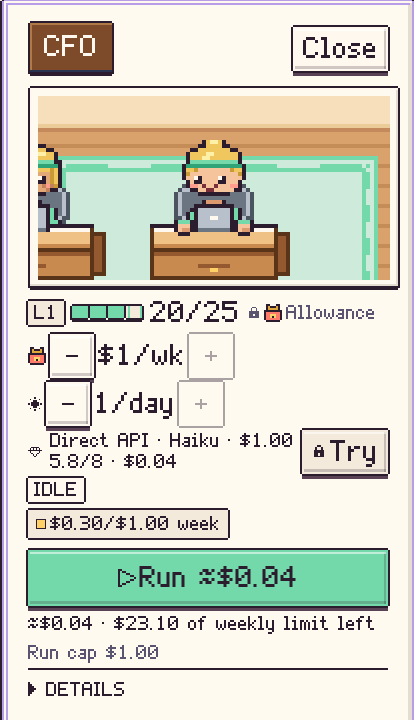
Cutting 92% of the words
The most useful change was also the least glamorous. We set a word budget and put it in a test, so a screen that grows too wordy now fails the build.

We measured the agent panel on a phone, using the same sample data each time:
| Version | Words in the panel | What changed |
|---|---|---|
| Before | 431 | Tabs for overview, live and progress, with most of the text below the fold |
| After the great cut | 32 | One status line, the action buttons, Details folded away |
| Phone pass | 22 | The lowest count, before harness controls existed |
| Today | 34 | Added a harness line and a Try button |
At the lowest point the cut reached 95%.
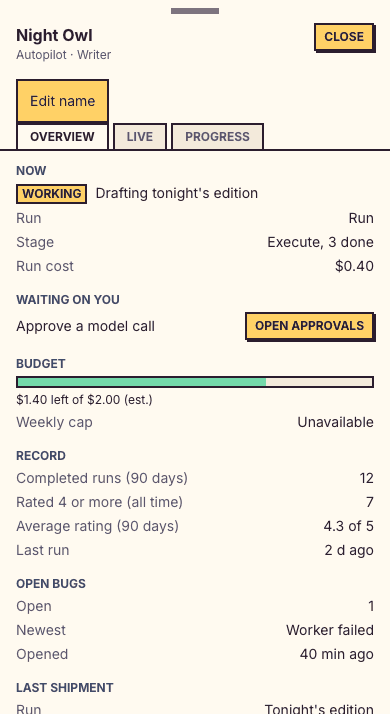
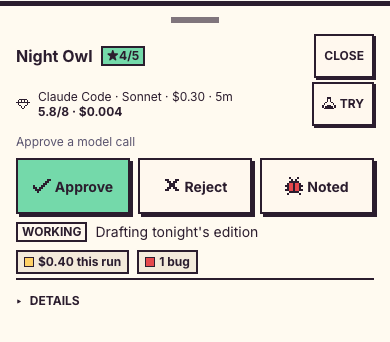
That last detail mattered. On a phone, the old sheet covered the desk, so you never saw the reaction to your own tap, and that reaction is what makes a game feel like a game.
Changing one thing at a time
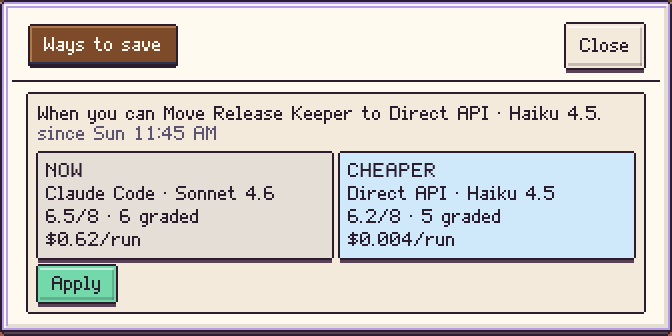
The move we care most about is Try. It changes exactly one harness setting, replays up to five of the agent's recent finished runs, quotes the whole cost and holds that money before any rerun starts. The card shows the two versions side by side, and you keep one.
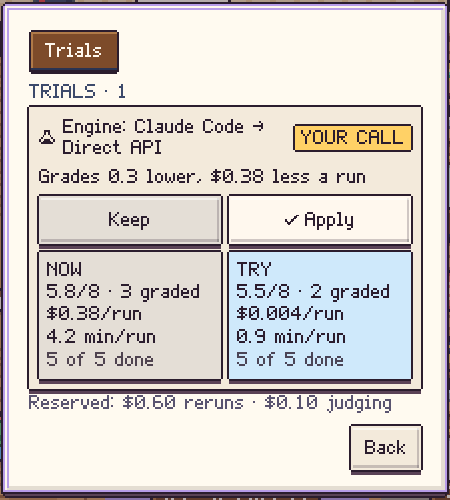
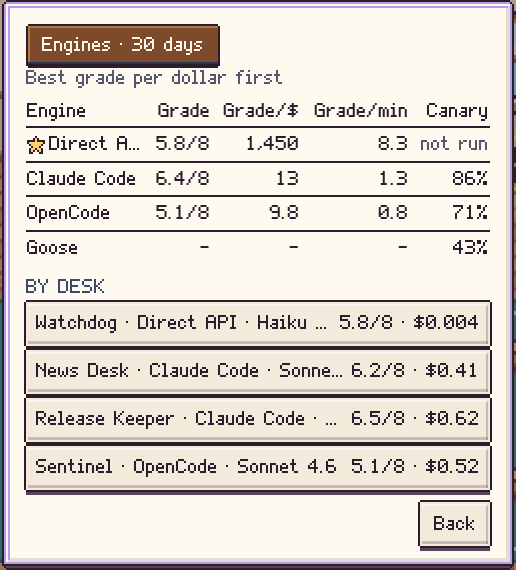
The Study ranks engines by grade per dollar, and the Mail room delivers cheaper-harness proposals as letters you can apply or undo.
None of this has run live yet. Trials open at level 3, and our highest agent was at level 2 when we checked on November 1. The harness proposer had made no proposal as of October 28.
We also gave the agents that watch our CI a real room, fed by our own GitHub Actions. Here it is replaying two real runs from October 28. A dependency bump (#4008) turned CI red: Backend Fast Checks failed on pip-audit, PR Gate failed, and the deploy was skipped. Then the fix (#4010) went green all the way through, and the VPS bot deployed it.
Smoke means a bench's last job failed, a bell means its last job was a successful deploy, and the tickets on the wall are queued jobs. All of that comes from the runner records. So does CI Steward's note on the platform repo, which named the red main branch, the cancelled merge checks and the disk guard on one of the runners. Our audit found every claim in that note true, and CI Steward passed 2 of 3 on the platform org in the latest round.
What's still not working
This is a work in progress, and the scorecard is mixed.
Live, the backend looks healthier than the score suggests. Since the last fixes, all 61 scheduled runs in the two orgs we track completed (33 on the platform org and 28 on the blog), with no cap refusals this week and $0.40 of the platform's $25 cap committed. Completing a run doesn't make it right, though. In our latest audit, 15 of 46 reports passed.
Progression is the shakiest part. The agents at level 2 got there because we imported our agent-led audit grades. Nobody played their way there. As of our last check on October 29, nobody had rated a run that week, and live runs earn no XP while the automated grader stays in shadow mode. The clips above show the loop working on sample data. We haven't yet seen it change how anyone behaves.
Three fresh reviewer agents, briefed as a game designer, a product designer and a pixel artist, scored each pass from screenshots alone. They saw only images, not the code or our reasons. They never got past 7, and we shipped under a stop rule instead of polishing forever.
The bigger gap is the grader behind the XP. It isn't good enough yet, and that's the subject of our next post.
Where we pick this up
Handover sheet · Nov 1Our notes for the next shift. If you run agents too, this list may save you a lap.
- OpenRate a real week of runsNobody had rated a run at our last check on October 29, so XP from ratings has never fired live.
Office desk sheet - OpenRun the first live harness trialTrials open at level 3, and our highest agent is at level 2.
harness.trial - WaitingLet the grader award XPIt stays in shadow until it agrees with the audit 85% of the time. It is at 61.5%.
FF_OFFICE_GRADE_ENFORCED - OpenGet charm from 7 to 8The design calls still open are the spend and next-run chips, larger letters on laptop sheets, and the phone sheet order.
Office HUD and sheets - OpenStop cutting off engine namesThe leaderboard still truncates long names.
Study leaderboard - KeepHold the word budgetThe panel sits at 34 words. Growth now takes a deliberate change to the budget, because the test fails otherwise.
office-word-budget.spec.ts
We run the Office on our own organisations today. If your team runs recurring agent work and wants to try this with us as a design partner, write to boris@curate-me.ai.
Comments
Loading comments...